Showing posts with label Mark Adair. Show all posts

Saturday, February 9, 2013

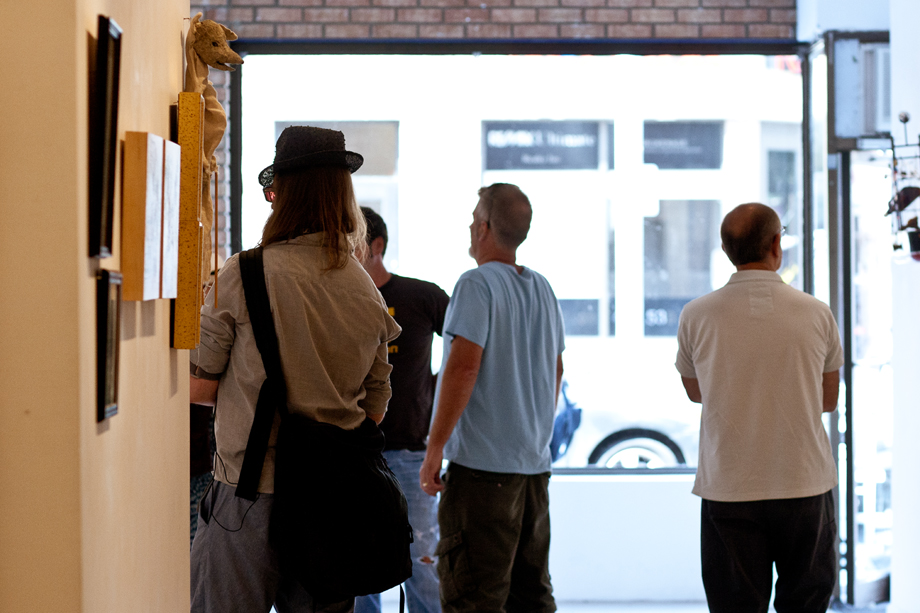
Mark Adair & Elizabeth D'Agostino Opening Photos


Thank you to everyone who came to Mark Adair's and Elizabeth D'Agostino's opening reception on February 2. More photos can be found on our Facebook page here.


If you'd like to learn more about Mark and Elizabeth, there will be a Q&A with invited guest Alex Jansen coming up on February 16 at 2pm. More information to come! 

Friday, July 27, 2012

Collective Vision at loop


Loop's talent pool is overflowing, said Globe and Mail critic R.M. Vaughan, and it's none the more evident than in Collective Vision, our current group exhibition. Come in on Sunday, July 29 at 3PM for a Q + A session with member artists Mark Adair and Libby Hague, and loop co-founder Richard Mongiat. The panel will be moderated by Will Huffman, Associate Director of the Toronto Arts Council.

Collective Vision features works by John Abrams, Mark Adair, Elizabeth Babyn, Yael Brotman, Heather Carey, Tara Cooper, Tanya Cunnington, Elizabeth D'Agostino, Sheryl Dudley, Martha Eleen, Eric Farache, Adrien Fish, Maria Gabankova, Sandra Gregson, Charles Hackbarth, Libby Hague, Linda Heffernan, David Holt, JJ Lee, Jane Lowbeer, Ian MacLean, Mary Catherine Newcomb, Maureen Paxton, Ester Pugliese, Barbara Rehus, Rochelle Rubinstein, and Yvonne Singer.

The show runs until August 12, 2012.

Photos by Patricia Novju


Tuesday, November 29, 2011

A Conversation between Mark Adair and Jane Lowbeer

A crankee by Jane Lowbeer
Mark: What is a crankee?

Jane:  It is a medieval tv (that is something we have in common --the medieval part) in that it is an early form of story telling that originally was accompanied with song.  It consists of a box with a scroll inside that can be turned by hand. The scrolls in these wall mounted crankees are monoprints on Japanese paper.

Mark:  Having spent some time with your work I have some thoughts and feelings to share.  It seems that the work is only nominally about the passage of time. Shelf life denotes the limits of usefulness before things should be discarded.

Jane: As long as something is on a shelf then it has a life and if it is thrown away than it is gone. For sure some of the pieces speak more about time than others. ie, -the one with the birds, Rendez-vous. In my mind, drawing the unfurling ribbon is about the unraveling of a day, or a year or a life time . And when all three birds line up in the drawing,  it represents a moment of time of connection  like when you notice the bird outside singing and  feel okay.

Mark: The scroll format harkens back to antiquity. Using it as well as you have places your work in an ongoing tradition which removes it from the mental list of things to be discarded.

Jane: What were traditional scrolls used for? Contemplation?  Isn't contemplation about the passage of time. "Shelf Life " is also about my own time line--  referring to my theatre days as the artistic director of the 'Crankee Consort'.

Mark: There is a wonderful quality to the manipulation of materials in the scrolls that does not 'gel' with the objects on the the shelves. I doubt if there is any specific inference you wish to make but there is clearly a reason for the juxtaposition. Would you care to comment?

Jane: A couple of people observed  that when turning the drawings it felt like  looking at music. Maybe the objects are riffing on a theme. It was a challenge to have the objects interact with the drawing at all moments. 

 Mark: There is a difference between narrative and poetry. The scrolls seem to be entirely poetic. No story specifically, just the skilled notation of things experienced.

Jane: I do agree these are visual poems more than stories .The person turning the crankee can stop the at any moment  creating their own composition

This conversation will be continued  on Sunday, December 4 at 1 pm. Join Mark Adair and Jane Lowbeer on December 4th at Loop Gallery to hear more.

Saturday, November 26, 2011

Loopers in the News

Persons of Interest by Gary Clement
Gary Clement has new works on display at Parts Gallery 1150 Queen Street East.

Sandra Gregson is one of the featured artists on World of Threads Festival website as the 40th "Weekly Fibre Artist Interview."

At loop gallery this weekend are Mark Adair and Jane Lowbeer. On the last day of their exhibitions, Sunday, December 4th, there will be a Q&A session. Instead of a moderator,  Mark and Jane will ask each other questions.

Thursday, November 10, 2011

Mark Adair and Jane LowBeer at Loop Gallery

loop Gallery is pleased to announce exhibitions by loop members Mark Adair entitled The Honourable Blood of Mr. E. Pussy, and Jane LowBeer entitled Shelf Life.
Mark Adair, The Honourable Blood of Mr. E. Pussy, charcoal on paper, 4” x 4”, 2011
 The Honourable Blood of Mr. E. Pussy is the latest installment in Mark Adair's ongoing series of over seventy tiny charcoal drawings entitled Death Drinks. In these new drawings we see a marriage fall apart and our hero Death fails as a family man. Nonetheless, there is a happy ending of sorts in this near-to-last chapter of the saga about which Peter Goddard of The Star writes 'Adair's genius is to frame Death's progress as if it were a TV sitcom...".

Mark Adair is a Toronto artist who does both charcoal works on paper and makes sculpture. His work was recently featured in the Spring 2010 Vie des Arts (English) and was the subject of Patrick Jenkins' 2007 documentary Death is in Trouble Now. Adair is a graduate of York University, Toronto (BFA 1979) and the University of Victoria (MFA 1982). He is a founding member of The Torontoniensis Collective with whom he exhibited for over a decade.

Jane LowBeer Untitled, detail of crankee, medium, 15” x 15”, 2011.
 In Shelf Life, Jane LowBeer's creative work continues to be inspired by the household objects that surround her every day. LowBeer uses handmade boxes that are also shelves, with cranks and painted paper scrolls; a kind of medieval TV. As the viewer turns the crank (hence the name ”crankees”), hand-printed images of jars, tubes and tape, string and thing a-ma-jigs roll.

Jane LowBeer started her artistic career as a printmaker studying at Atelier 17 in Paris. As artistic director of the multi-media theatre company, The Crankee Consort, she designed and constructed puppets and sets for almost twenty years. During her career she has exhibited in New York, Montreal and in Europe. Her works have granted her prizes, are included in private and public collections, and can be viewed at Loop Gallery, Open Studio and the Nikola Rukai Gallery.

Please join the artists in celebrating the opening reception on Saturday, November 12th from 2-5 pm. Learn more about Mark Adair and Jane LowBeer’s work during a Question & Answer Session at loop on Sunday December 4th, 1PM.

Monday, August 9, 2010

loop Gallery presents Faithful and Faithless Messengers


Faithful and Faithless Messengers 

   
Mark Adair
Catherine Daigle
Patrick Jenkins
Alistair Magee
Mary Catherine Newcomb
Rochelle Rubinstein
 
August 11 - 22, 2010
Reception: Thursday, August 12th, 6 - 9 pm
  
loop Gallery is pleased to announce an exhibition entitled Faithful and Faithless Messengers by Mark Adair, Catherine Daigle, Patrick Jenkins, Alistair Magee, Mary Catherine Newcomb and Rochelle Rubinstein. The exhibition addresses the dual nature of the artist as both messenger and art historian aware of the long history of messengers in art, be it The Virgin Mary, The Lord of the Flies, The Redeeming Angel, or just  language itself  "... lost in a sea of paint."  Works range from sculpture, printmaking and painting through to animated film.

Mark Adair:  “After my father died my mother told me that she wanted an angel for her tombstone. Now angels are not rare in art history so I did my due diligence and tried to figure out what one would look like. Then I found a slab of marble in the ruins of an old insane asylum and chipped and scraped away at it for about a decade on and off until I came up with this piece. The style comes from a Sumerian cylinder seal I saw in The Louvre. Perhaps angels were still around then as the Mesopotamians were closer to the beginning of time.”  


Catherine Daigle:  Between 2001 and her death in 2006, Catherine Daigle did a number of works using insects and stenciled images of flies. The little piece in this show Hissing for Flies was by inspired by Isaiah 7:18 (in the Old Testament), "And it shall come to pass in that day that the Lord will whistle for the fly". Daigle made works on acetate, plexiglass, and paper that were suggestive of clouds of flies, a phenomenon most us associate with foreboding.

Patrick Jenkins:  In this exhibition Jenkins presents two films along with Giclèe prints of some of the individual paintings created in the making of the movies. Labyrinth is a surrealistic mystery in which a detective encounters strange phenomena and beings from the afterlife. Towers Rising, an animated film loop, was created spontaneously, and in retrospect, Jenkins realizes it was a response to 9/11. Jenkins’ work explores the journey of the spirit through life, the imagination, and in Towers Rising, a desire for gentleness in a post 9/11 world.


Alistair Magee:  The technique employed to make these paintings involves repetitive stenciling of written language used as a system or grid to support more expressive brushwork. Palimpsest is central to the work. In all of his work since 2000, Magee has attempted to unmoor legibly meaningful but formulaic language and pull it back into the realm of abstraction. The stasis of inscription is released to ambiguity in a sea of paint.

Mary Catherine Newcomb:  Assumption of the Virgin 1996. “I have always been interested in the relationship between the spiritual and the corporeal, partly because I was raised to think that there wasn't one and partly because I am a sculptor. This piece plays off the Catholic feast of the Assumption (celebrated August 15th) when the BVM was bodily received into heaven. There is an intellectual debate as to whether she died before the ascension or was vacuumed up just as she was about to die - I can't see that it matters as she was only dead for a bit. Assumption can be an active or passive verb - meaning two different things... the gesture of the legs suggests questions about the relationship between the body and the sacred. The beeswax refers to, and smells like, Catholic church candles of my childhood. Beeswax has also been used to sculpt bodies over the bones of the saints – i.e. flesh out relics. The piece is cast from my own body and the legs are hollow.”

Rochelle Rubinstein:  Over & Above is the newest addition to an ongoing project called Marginalia, which consists of hundreds of printed, painted and carved wood panels. It was originally inspired by the 16th century codices of Mexico. When the Spanish army of Cortez converted the Aztecs to "the true faith" at sword point, it was under a banner bearing an image of the Virgin Mary. In Over and Above, a blond Mary holds her boy, surrounded by archangels and messengers and by the Hebrew phrase, "And his banner over me was love" (Songs of Songs in the Old Testament). It is a riff on The Book of Kells, the 7th to 9th century Irish manuscript codex. Images of woman, boy, angels, stones, babies, and words have been printed and over-printed on the four large wood panels. This repetition leads to variation and invites reflection.


Please join the artists in celebrating the opening reception on Thursday, August 12th from 6-9 pm. 

Monday, April 19, 2010

Video Clip from the Conversation with Mark Adair and Mary Catherine Newcomb

The gallery is closed this week for installation and it will no longer be possible to see the beautiful work of Mark Adair and Mary Catherine Newcomb. However, there is an enlightening video clip of the Question and Answer session with Mark and Mary Catherine which was facilitated by Gordon Hatt.

Listen to this four minute clip and learn more about the artistic process. Click on the Vimeo link here.

Sunday, April 18, 2010

Daphne and Apollo


Today is the last day to see this extraordinary sculpture by Mark Adair called Daphne and Apollo. When I saw this, I marveled at Mark's incredible skill at making wood come alive.

Loop Gallery is open today from 1 to 4 pm. Also on view are Mark's drawings and Mary Catherine Newcomb's magical bunny sculpture called Chocolate.

Saturday, April 17, 2010

Mark Adair & Mary Catherine Newcomb in conversation with Gordon Hatt.

Join us at Loop Gallery TODAY Saturday April 17th for a Question and Answer session at 3pm. Gordon Hatt will facilitate the discussion with Mark Adair and Mary Catherine Newcomb.

Mark Adair is a Toronto artist who does charcoal works on paper and makes sculpture. His work was recently featured in the Patrick Jenkins documentary, Death Is In Trouble Now, airing on BRAVO! Television, which was also the basis for a 25-year retrospective of Adair's work mounted at Brock University's Rodman Hall Arts Centre. Adair is a graduate of York University, Toronto (BFA 1979) and the University of Victoria (MFA 1982). He is a founding member of the Torontoniensis Collective with whom he has exhibited since the mid 1990's. He has exhibited with Loop since 2004.

Mary Catherine Newcomb was born and raised in Montreal. She received her art education at University of Waterloo and York University. She currently works and resides in Kitchener, Ontario. She has received numerous grants and awards and her work has been exhibited internationally.

Gordon Hatt is an independent arts writer and curator living in Kitchener, Ontario. He was the Director/Curator at Rodman Hall Arts Centre in St. Catharines from 2004 to 2007 and before that the Curator of Temporary Exhibitions at Cambridge Galleries, Cambridge Ontario.

Mark Adair's Death's Children & Mary Catherine Newcomb's Chocolate exhibitions run until Sunday April 18th. Gallery hours are:  Saturday, April 17th 1-5pm and Sunday, April 18th 1-4pm

Wednesday, April 14, 2010

Mark Adair on Artists and Art Critics

As artists we have, it seems to me, two distinct jobs. One is making art, and as Catherine Daigle used to say, "... an artist can only make the art they make." And the other job is "getting it out there". What Daigle meant was that the struggle of art production is very personal. And as Michel Denis, a Montreal artist, said to me many years ago, it's that idiosyncratic voice that is what makes a thing special (to paraphrase). I can paint a vase of sunflowers, but Van Gogh paints a Vase of Sunflowers. It's not perhaps 'better', but somehow it is just better. In "getting it out there", we stretch out our necks only to expose ourselves to the sharp sword of the critic.

The critic's sword has two edges. One cuts for the artist, and the other slices into the artist. In speaking with a colleague the other day I learned that she has felt the sting of a reviewer. Not a bad review at all, just one simple word that made her wonder about an aspect of her work. Should it be seen this way, or that way? A semantic twist that can twist one's understanding. I have really felt the sting of the reviewer's pen to the extent that it made me wonder what the hell (at the very core of my being) I was up to. You might say that it's a nice problem to have and I would concur, but with caution. What real use is a review other than the undeniable pleasure of seeing one's name in ink? It has been suggested that a good review can give the reader (collector) confidence to perhaps make a purchase. Well, that is a very important part of our business. But I would argue that arts writers, and I have had the very real pleasure of working with several good ones, have a raison d'etre all of their own. Not separate from artists but joined at the hip so to speak. Arts writers and arts journalists wield their wicked little pens (cameras and computers, blogs and magazines) to write into existence their own cultural visions. Think about the implications of a 'simple'  review. For every show chosen by the reviewer there are hundreds ignored. That's a lot of resentment. But more to the point the selection process of arts journalists underscores how this one aspect of arts culture works; certain shows are chosen to be written about. Certain artists are brought to the public's attention. A discourse is established. As artists we tend to whine about the tail wagging the dog. I think this whining might might be a big mistake. The fact is that we are a small part of a very big cultural industry. When I get reviewed these days, or someone flatters me by noticing my efforts, (with praise, faint praise, or even mild ridicule) I try to remember my place in the food chain. The region of south western ontario is a great place to be an arts worker. Everything is up for grabs; anything can happen. We are very blessed.

Mark Adair

Saturday, April 3, 2010

Gary Michael Dault Reviews the Current Show at Loop Gallery


Art critic Gary Michael Dault has written a review in today's Globe and Mail Newspaper of the current show of Mary Catherine Newcomb's and Mark Adair's work at LOOP Gallery. His review is called "A bunny with a chemical scent and a hint of myth" and can be read here.

Of Mary Catherine's Newcomb's hand sculpted rabbit, Dault says "Stretched out on its bed of crushed stone, Newcomb's chocolaty rabbit looks like a victim - like a creature sacrificed, as both primitive rituals and the story of Jesus's death, rebirth and scension would have it,  in order to bring about the re-emergence of new life. In Newcomb's skillful hands, it's no distance at all from the low comedy of her mucking about in an animal feed bin to the generation of myth. Her bunny may be made of ignoble stuff, but it has about it an aura of sanctity."

Dault also offers high praise to Mark Adair's work calling them "brilliantly spooky" and comparing his "tiny, astonishingly detailed charcoal drawings" to Hans Holbein's Dance of Death woodcuts from 1538.

The exhibition by Mary Catherine Newcomb and Mark Adair continues at Loop Gallery until Sunday, April 18, 2010.

Tuesday, March 23, 2010

Upcoming Exhibitions by Mark Adair and Mary Catherine Newcomb

LOOP Gallery is pleased to announce exhibitions by loop members Mark Adair and Mary Catherine Newcomb.

Mark Adair’s Death’s Children is a new series of small charcoal drawings that completes Death Drinks, a narrative about the adventures of Death in the modern world. Adair has worked on and off on the series for a decade and it has been exhibited in many shows in various stages of development. Both the subject matter and the labour intensive and detailed style of the work are inspired by the art of the 14th Century in western Europe.

Mark Adair is a Toronto artist who does charcoal works on paper and makes sculpture. His work was recently featured in the Patrick Jenkins documentary, Death Is In Trouble Now, airing on BRAVO! Television, which was also the basis for a 25 year retrospective of Adair's work mounted at Brock University's Rodman Hall Arts Centre. Adair is a graduate of York University, Toronto (BFA 1979) and the University of Victoria (MFA 1982). He is a founding member of the Torontoniensis Collective with whom he has exhibited since the mid 1990's. He has exhibited with Loop since 2004.

Mary Catherine Newcomb is exhibiting a four foot long reclining "chocolate" hare at Loop Gallery. The hare regards the viewer balefully and actually consists of a malleable material that smells slightly oily or rancid. A suspended, oversized apple blossom crown that is made from copper, bronze and steel accompanies the rabbit. While heralding the beginning of spring, this exhibition juxtaposes ideas about beauty, illusion, consumption and our complex and often romantic relationship with nature.  

Mary Catherine Newcomb was born and raised in Montreal. She received her art education at University of Waterloo and York University. She currently works and resides in Kitchener, Ontario. She has received numerous grants and awards and her work has been exhibited internationally.

Please join the artists in celebrating the opening reception on Saturday, March 27th from 2-5 pm.