Wednesday, June 12, 2013

Loop's Summer Correspondent Sarah Letovsky visits O'Born Contemporary


 Edith Maybin, The Girl Document, Untitled # 1, Chromogenic Print, 90 x 60 inches, 2013; gallery documentation. 
(Photo courtesy of O'Born Contemporary.)

Edith Maybin at O’Born Contemporary

Sarah Letovsky


Do you remember what it feels like to be an adolescent? That painful state of burgeoning sexuality, lingering childhood, chipped nail polish, and embarrassing sex ed classes? I remember it vividly, and so does Edith Maybin. I had the good fortune to catch her exhibition at O’Born Contemporary, “The Girl Document,” just before it closed on June 8th.

O’Born Contemporary is located at 131 Ossington, right next to Crafted coffee and across from Bellwoods Brewery, a ten minute walk from loop. It’s a great place to pop by for a dose of contemporary art in between coffee runs and vintage shopping.

“The Girl Document” is a series of large photographic prints, or “documents” as Maybin labels them, concerned with that specific time in a girl’s life where she suddenly becomes caught between binaries of childhood and adulthood. We see snapshots of an adolescent face, a piece of birthday cake, mirrors, and star-shaped glitter.


Edith Maybin, The Girl Document, Untitled #2, Chromogenic Print, 2013. 
(Photo courtesy of the artist.)
Upon deeper investigation, this imagery has a saccharine sweet quality of excess and a threatening undertone; the swirling saturated colours, the hints of broken glass, pieces of fur, blood. It’s an unsettling fracturing of childhood and of identity. Despite moments of overt representational symbolism in Maybin’s still life arrangements, “The Girl Document” is still very much defined by its particular formal and technical framework which, curiously, is rooted in abstraction and distortion.

O’Born's Associate Director, Rachel Anne Farquharson, spoke to me about Maybin’s process, which is done  in-camera, by wrapping a piece of silver mylar around the lens. This reflective silver bends the light, effectively creating a swirling portal around the edge of the photo. It’s a visual manifestation of the lens itself, a voyeuristic snapshot of puberty from the outsider's perspective of a mother, watching her child experience the pain and confusion of growing up.

"The Girl Document" proves to be a collection of work that is at once celebratory and also threatening and fearful - a deeply self-conscious examination of the relationship between mother and daughter.

Maybin's work can be seen on the O’Born Contemporary website at http://www.oborncontemporary.com/exhibitions/2013_Edith_Maybin_Solo.html or on the artist’s site at http://www.edithmaybin.com/. O'Born Contemporary’s next major exhibition is “Backscatter”, a series of work by Kate McQuillen. The opening reception is friday june 21st from 6-9, and runs until july 27th. Don't miss it!

(All images courtesy of O'Born Contemporary)

Last Week for Eric Farache: Quixtopia and Larry Eisenstein: Negative Capable

Sunday June 16 is the last day for Eric Farache Quixtopia and Larry Eisenstein Negative Capable.
Gallery Hours are:
Wednesday to Saturday 12 noon to 5 p.m.
Sunday 1 p.m. to 4 p.m.


Larry Eisenstein
Negative Capable

loop Gallery is pleased to announce a new exhibition by member artist Larry Eisenstein entitled, Negative Capable.
Romantic poet John Keats used the term negative capability to describe an artist's receptiveness to the world and its natural marvel, and the struggle of human beings to transcend and revise their contexts. Philosopher Roberto Unger appropriated Keats' term in order to explain resistance to rigid social divisions and hierarchies. For psychoanalyst Wilfred Bion, negative capability was the ability to tolerate the pain and confusion of not knowing, rather than imposing ready-made or omnipotent certainties upon an ambiguous situation or emotional challenge.
Eisenstien links Keat’s interpretation of negative capability to the heart, Unger’s to the body, and Bion’s to the mind. Together, this trinity of intimacy, passion, and commitment encapsulate the joys and anxieties Eisenstein experiences as he creates numerous meticulously patterned drawings of free-form viral clusters.
Eisenstein is a Toronto-based visual artist who teaches art at Humber College. His work has been placed in private collections across North America.

Image: Ring (detail), ink on paper, 8.5 x 11 in, 2013


Eric Farache
Quixtopia

loop Gallery is pleased to announce Quixtopia, a new exhibition by member artist Eric Farache.
Farache's Quixtopia plays with visions of future utopias from a mind that exists in the tipping point between boyhood and manhood, a future where magical creatures and naked ladies could both exist. An imagined perfected reality from that narrow window, precisely when one foot is in childhood heroes, another in x-rated fantasy.
Every canvas/sheet of paper is a utopia that the artist attempts to build up or destroy with each mark. A utopia is an ideal, forever not to be realized, as soon as something becomes concrete and tangible the ideal is lost- ideals which are the very windmills we hurl ourselves toward again and again.
These paintings reveal broken perfections, moments of happiness gone awry, these befuddling and lost utopias- these Quixtopias.
Farache was born in 1971. He received a Masters in Fine Art from the University of Leeds, and is an Alumni of the Ontario College of Art in Toronto where he lives and works. Trained in classical painting techniques, he has been working in photography for the past 10 years, while maintaining elaborate sketchbooks as part of his artist practice. Quixtopia, is Farache’s second show of larger painted works with loop Gallery.

 Image: Hail! Hail! The gang is all here (detail), watercolour on paper, 22 x 30in, 2013

loop Thanks : AUDAXlaw Sumac.com

Monday, June 10, 2013

Photographs from Q & A with ERIC FARACHE, LARRY EISENSTEIN and OLEKSANDR WLASENKO

On Saturday June 8th Eric Farache and Larry Eisenstein were in conversation with Oleksandr Wlasenko to talk about their work.
Continuing until Sunday June 16: Eric Farache Quixtopia and Larry Eisenstein Negative Capable.


Thursday, June 6, 2013

Q & A THIS SATURDAY WITH LARRY EISENSTEIN, ERIC FARACHE AND OLEKSANDR WLASENKO

This Saturday June 8th at 2 p.m. we're celebrating the Dundas West Fest with an artists' talk featuring Larry Eisenstein and Eric Farache in conversation with Oleksandr Wlasenko.

Loop's Summer Correspondent Sarah Letovsky visits LE Gallery


Have you met Sarah Letovsky? She's running a hot new spot on our blog called "The Westside Loop." Check back every week to see what Sarah has to say about another great new show in Toronto's West end! Check out her first post about Scott Waters' latest show at LE Gallery.


Scott Waters at LE Gallery


Sarah Letovsky


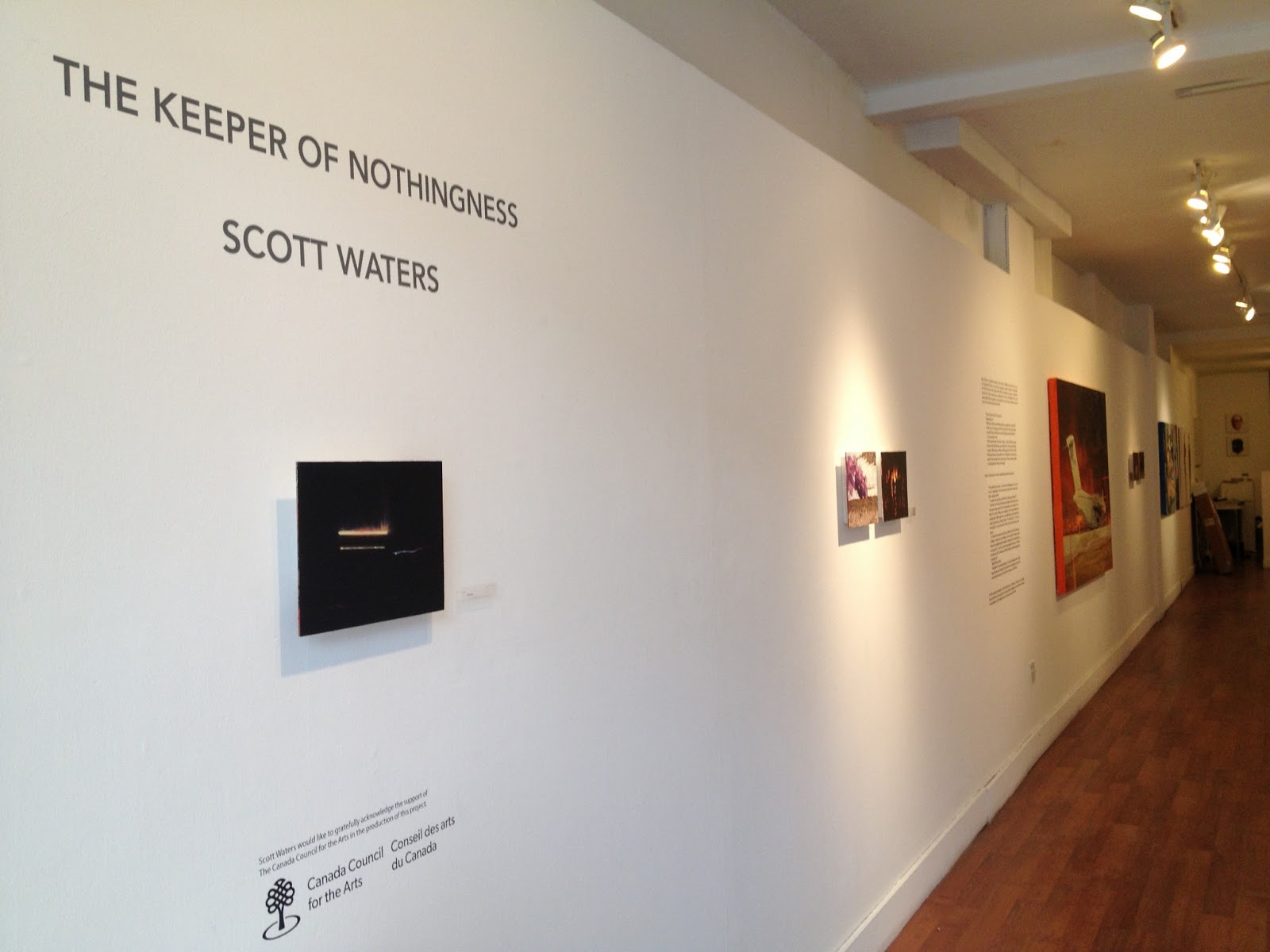
Canada's involvement in the war in Afghanistan is not often a topic of artistic discussion, but for artist Scott Waters, the nature of modern warfare serves as the focus for his latest exhibition, “The Keeper of Nothingness”.


When you first enter LE Gallery at 1183 Dundas Street west, you’re immediately drawn to the 48” x 72” piece Mile Kilometer Zero (2012), a massive depiction of a Canadian military aircraft. It looms menacingly against the red sky, a striking symbol of Canadian power in a foreign country, and not without references to a tomb or coffin.


Waters served as an infantryman in the Third Battalion of Princess Patricia’s Canadian Light Infantry from 1989 to 1992, stationed in Alberta and British Columbia. In 2006, as part of the Canadian Forces Artist Program (CFAP), Waters visited CFB Gagetown NB to observe India company, 2 RCR train for the types of situations they would encounter in Afghanistan. He also flew to Afghanistan to join his former battalion as they trained the Afghan National Army.


For an artist, the experience of training for war and being in Afghanistan is one of duality - seeing through the eyes of both a soldier and civilian. “The Keeper of Nothingness” is full of these self-conscious conflictions and dualities. The paintings themselves are a thematic and formal conflict of light and dark. Water’s style itself is expressive, light handed and gestural, a beautiful play of oranges and blues, yet it is deployed to grapple with threatening and ominous subject matter. Tracers (For Greff) (2012) depicts happy orange streaks dancing across a night sky - a poetic representation of Tracer bullets, which are used to light up a bullet stream to track live fire and to correct aim.


From his personal statement, Waters comments on this intentional duality in his work: “The Keeper of Nothingness also considers the liminal space — where one set of norms is exchanged for another. This might be mountain to valley, but it might also be safety into chaos, or representation into abstraction”. Water’s work is a not an explicit comment on his time in the Canadian Forces, or a political statement. Rather, it tells a story about the human experience of a modern war, and the effect it has on real people. Reading between the lines, there is a story of fraternal bonding, post traumatic stress, violence, and of cross-cultural pollination.


"The Keeper of Nothingness" closed on June 2nd. Water’s work can be seen on the LE Gallery website, (http://le-gallery.ca/exhibitions/2013/175/the+keeper+of+nothingness/). 


Be sure to check out LE Gallery’s upcoming exhibit of Quebec painter Nathalie Thibault, opening june 7th

Tuesday, June 4, 2013

Photographs from Eric Farache and Larry Eisenstein Opening

Eric Farache's Quixtopia and Larry Eisenstein Negative Capable opened May 25.
Here are photographs from the opening reception.
The exhibitions continue until June 16.


Monday, June 3, 2013

Libby Hague exhibits at the Japanese Paper Place and Trois-Rivières


 Libby will have two works in the exhibition "A Commitment to Washi:  Canadian artists exploring Tosa washi" which is on June 6 to July 30 at the Japanese Paper Place, 77 Brock Avenue, Toronto. 
The opening is June 6 from 6 to 8 p.m. There is a panel discussion June 20 from 6:30 to 8 p.m.
The exhibition travels to Tokyo in November.


Libby will also have five works in the Biennale internationale d’estampe contemporaine de Trois-Rivières.